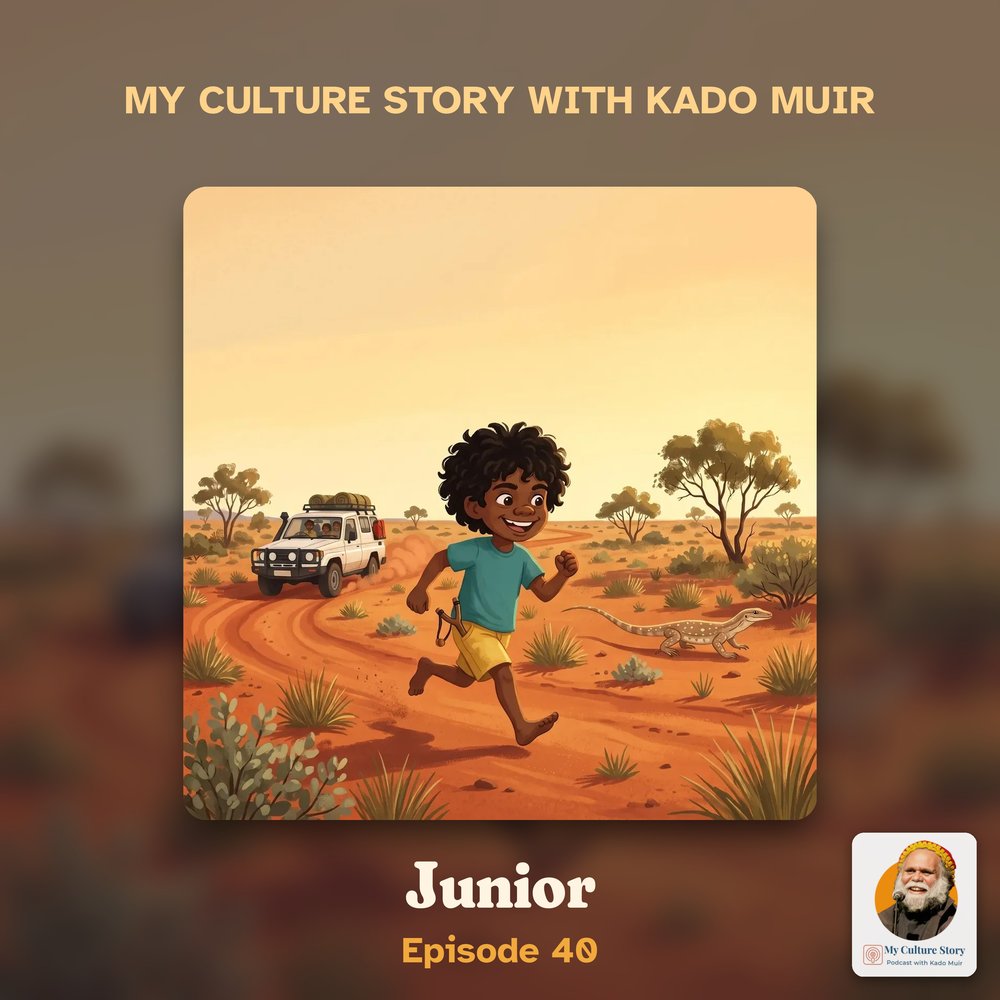
Junior: A Broken Window, a Mamu and Hot Damper
Junior's shanghai shot breaks the Toyota window, and he runs into the scrub. Kado Muir reads his story about a big, loud, loving family camping out, then talks about Tjamu, the barnga, the name Kumarnu, the Mamu and who looks out for you.
Chapters
- Intro
- Welcome
- Where the story comes from
- Reading the story
- The culture and language in the story
- Questions to talk about
- Close
Transcript
Made from the recording. Tap a time to listen from there.
Hello, everyone.
Welcome back to My Culture Story with Kado Muir.
This is episode 40.
My name is Kado Muir.
I'm a Ngalia man from Leonora, in Western Australia.
Before we start, I want to acknowledge Country.
I'm recording to day in the Country you're on].
I pay my respects to Traditional Owners, and to Elders past and present.
I also pay respects to any Aboriginal listeners today, wherever you are.
So, grab a cuppa.
Or if you're in the car, hold on tight, and keep your shanghai in your pocket.
Today's story is called Junior.
and It's a godder family on a long drive out bush.
There's a goanna, a broken window, and a boy who runs off and hides in the scrub.
There's a good feed too, and a Mamu waiting in the dark.
It's a funny one.
It's a warm one.
and I hope you like it as much as I do.
First, a little bit about where it comes from.
so about twenty years ago i was out bush with my brothers and family and we had our
nephews goodness must be near thirties now but back then he was a young fellow young a ratbag
and very keen and eager on the hunting trip say this story is based on a true story
ah i did write a little book about it i called it the little mongrel but then realizing
ah aboriginal english and are ways of speaking mayi not be politically correct when we're doing or talking
to a wider audience say we now bring that story to you in the new form with junior
junior is the lead character and it just makes me smile remembering the trip the times and all
his little adventures so sit back and enjoy
Junior is a story about Aboriginal family life.
and It's the everyday kind, with a Toyota, flat tyres, damper and a lot of laughing.
In the story, Junior's Tjamu is the old man in the front seat.
Tjamu is the grandfather.
And he's the one who speaks up for Junior when things go wrong.
There's Uncle Denny, who drives.
There's Mum, and Dad, and Aunty Annie.
And there are heaps of kids.
You'll hear the old man teach the kids how to clean a goanna the proper way.
and You'll hear the grown-ups call Junior's dad by special name.
You'll hear them hush the kids when the sun goes down.
All of that comes from how our families really live and look after each other.
going on country is an important part of our cultural traditions it's also an important part of our
spirit and our emotional and social well being so this activity of a family, going on country is
one of the strongest connections that abigual people have through and every day whilst olivent Anyway, that's enough
from me.
Here's Junior.
"Barnga! Barnga!"
Someone in the back seat had spotted a goanna. Junior already had his shanghai out.
"Uncle, shoot him? Shoot him, inni?"
"No! Stop!"
CRASH! Too late! The back window turned into a thousand tiny diamonds.
Uncle Denny stamped on the brake. The Toyota jumped, shuddered and stalled, and the dashboard lit up red, green and yellow.
"Aaahhh!" yelled the whole back seat. "JUNIOR!"
Junior was first out. He ducked, jumped and ran, legs pumping, straight into the scrub.
The barnga got such a fright it stood up on its back legs and ran off into the bush, just as fast.
"Wait till I catch that boy!" Dad roared.
Junior crouched behind a bush. He didn't dare breathe.
Dad squinted hard at the scrub, pretending he couldn't see him.
The other kids pointed and giggled. Then Tjamu, the old man in the front seat, began to chuckle. Soon the grown-ups joined in, and everyone was laughing.
It was their third stop that afternoon. Two flat tyres already, and now a broken window.
"We might as well camp here," said Uncle Denny, wiping away tears of laughter. "I'll fix that last tyre while it's still light."
Dad taped up the window. "Hey, you kids, get some wood for the fire!"
"Junior!" called his mum. "Come on, you better come back. Might be a Mamu in the bush."
The kids dragged in firewood while the grown-ups lifted three more barnga out of the back.
"TK, take this one to Tjamu," said Uncle Denny. Then he called across to his father: "Mama, kuka palyala ma nintilku tjitji:pirniku."
"Yuwa, all right," said the old man.
Tjamu snapped a little hooked stick off a mulga tree. The children gathered close to watch.
"You see, kids, this is how we clean the barnga. This is our law. Some people do it another way, but not us."
"Nyeh, Kumarnu, kuka mantjilla," Tjamu called to Junior's dad at the fire.
Kumarnu singed the barnga in the flames and scraped them clean. Tjamu tucked their back legs up, "the handcuffs", ready for cooking. Then Kumarnu buried them in hot sand and coals. Dinner was cooking.
At the other fire, Mum mixed flour for damper.
"Junior, come on, you better come back now!"
The other Toyota finally rolled in. It drove slowly around looking for the right spot to camp: not too close, not too far.
Five more kids tumbled out and ran to join the watch on Junior's bush.
Junior had started breathing again. He sat with his back to the camp, tossing little rocks at a stump.
He wasn't listening to anyone.
But the shadows were getting longer.
Back at camp the fires were burning, dinner was cooking and the kids were playing.
Junior's ears and eyes reached out into the bush. He listened for every sound and watched for every movement.
He had a choice to make. Stay out here, where a Mamu might be watching... or go back and face Dad.
Junior crept a little closer to camp.
"I can see him!" "There he is!" "Come on, Junior, before a Mamu gets you! Look behind you, one's coming! Run!"
"Hahhh, you kids, don't say that," Aunty Annie whispered sharply.
As the dark came, the grown-ups' voices went quiet. The men stood around the fire, each one facing a different way, watching the bush.
"Come on, Junior," called Mum, buttering the hot damper. "You want some mayi?"
"Don't give that boy anything," growled Dad. "He can stay out there with the Mamu."
"Oh, go on, son," said Tjamu. "Don't be hard on my tjamu. It's finished now, you taped the glass up. Let him come have kuka. Look, it's a nice fat one."
"Yeah, go on, Kumarnu, it's all right," said Uncle Denny. "Anyway, you gotta come help me fix these tyres."
"Might be all right for you," Dad grumbled. But he picked up some damper and walked off to help Denny.
Junior knew his Tjamu and his uncle had cleared the way. And he was more scared of the Mamu than of Dad.
So he sneaked back to the fire and sat down beside his Tjamu, hot damper in his hand, butter and golden syrup dripping through his fingers.
"You can camp here tonight," said Tjamu, pointing to the blankets by the fire.
Far away, a bushfire glowed along the edge of the desert.
The End.
Well, Junior came back to the fire in the end.
And he got the best seat, right next his Tjamu.
I want to talk about a few things in the story.
First, Tjamu.
That's what Junior calls his grandfather.
And Tjamu calls Junior 'my tjamu' too.
The word works both ways.
Grandfather and grandchild.
Grandparents are a child's friends.
They're a safe place when things go wrong.
and That's why Tjamu speaks up for Junior at the fire.
Next, the barnga.
That's the goanna.
When Tjamu shows the kids how to clean it, he says, 'This is our law.' People, animals and
plants share a spirit from the Dreaming.
So when we hunt, we show respect.
We prepare food the way our ancestors taught us.
Tjamu teaches it.
Nintilku is the word for show or teach.
And you heard kuka, which is meat, an animal to eat.
And mayi, which is food.
The damper is mayi, and that nice fat barnga is kuka.
Now, Kumarnu.
You heard Tjamu and Uncle Denny call Junior's dad Kumarnu.
In our culture, the name of someone who has passed away is not spoken.
We say pukurra for a person who has passed away.
Someone who shares that name is called Kumarnu instead.
Sometimes for years.
It's a way of showing respect.
Then there's making camp.
Each family makes its own camp, not too close not too far.
away In the old days you never walked into someone else's camp without asking.
A wiltja is a shelter of boughs and spinifex to keep off the rain.
so A wet weather camp and a yule is a windbreak of branches to keep off the cold
wind.
And the Mamu.
Children are told a Mamu waits in the dark for kids who wander too far from camp.
After sundown is the time to be quiet and stay close to the fire.
That's why the grown-ups hush the kids.
And it's why Junior finally comes back.
the Last thing.
Did you notice Uncle Denny calls Tjamu 'Mama'?
That means father.
In Aboriginal families, your father's brother is also your father.
and Your mother's sister is also your mother.
So a child has many people looking out for them.
Like Junior does.
One more word.
Yuwa.
It means yes.
Or, it means passit to me.
Handy at dinner time.
you could say you are korgayua noah that's yes pass me the main
right Now, a few questions you can talk about with your family.
Pause the show if you like.
just Take your time.
One.
Tjamu is the old man in the front seat.
How is he related to Junior?
Two.
Junior broke the Toyota window and hid in the scrub.
Who helped him come back to camp?
And what did they say to Dad?
Three.
Tjamu and Uncle Denny call Junior's dad Kumarnu.
Why might a person be called by a name like that?
Four.
What is the Mamu?
Why did Junior de decide to come back to the fire after dark?
And five.
Mum, Tjamu and Uncle Denny all looked out for Junior.
Who looks out for you in your family?
That last one is my favourite.
Ask your Nan, or your uncle, or your aunty.
You might hear a good story.
well Thank you for listening to My Culture Story with Kado Muir.
Thanks for spending your time with Junior and his family.
if you want to read the links for reading the ap and read it and listen to me
narrate you'll find they'll details in the show notes.
and we also have a kindled edition and a paper back that you can purchase from amazon If
you liked today's story, tell a friend.
Tell your cousins.
Tell that uncle who's always got a story of his own.
Come back next time for another story.
Until then, look after each other.
And stay close to the fire after dark.
balloona nolannago I'm cadomo